What Is the Employee Benefit Plan Audit Quality Center (EBPAQC) and Why It Matters
The Employee Benefit Plan Audit Quality Center (EBPAQC) is a key professional resource focused on improving the quality of employee benefit plan audits. Here’s what it is, why it matters to plan sponsors, and how it can influence your auditor selection.
If your plan needs an audit, the stakes are higher than many plan sponsors realize. A benefit plan audit isn’t just a “check-the-box” exercise—it supports your annual reporting and can affect whether your Form 5500 is accepted or flagged. That’s where the Employee Benefit Plan Audit Quality Center (EBPAQC) comes in. Understanding what the EBPAQC is (and what it isn’t) can help you make a more informed decision when hiring an auditor.
What is the Employee Benefit Plan Audit Quality Center (EBPAQC)?
The EBPAQC is a voluntary membership center created by the American Institute of Certified Public Accountants (AICPA) to help improve the quality and consistency of employee benefit plan audits. In plain English: it’s a professional community and set of resources aimed at helping CPA firms perform better audits of plans like 401(k)s, 403(b)s, defined benefit plans, ESOPs, and health & welfare plans.
EBPAQC member firms commit to certain expectations, such as:
Following EBPAQC membership requirements (including audit quality-related practices)
Staying current on employee benefit plan audit standards through training and technical resources
Participating in audit quality initiatives intended to reduce common errors and strengthen documentation
It’s important to clarify: EBPAQC membership is not a government certification, and it does not guarantee a perfect audit. However, it is widely viewed as a meaningful signal that a firm takes benefit plan audits seriously and invests in specialized competence.
Why EBPAQC matters to plan sponsors and HR teams
If you’re responsible for plan oversight, vendor management, or compliance, you’re ultimately trying to reduce risk—especially around reporting and fiduciary responsibilities. A low-quality audit can create real downstream problems, including delayed filings, rejected filings, additional fees, and potential scrutiny.
EBPAQC matters because it often correlates with better audit readiness and stronger audit execution in areas where plans commonly struggle, such as:
Eligibility and deferral testing: confirming the right employees entered the plan at the right time and contributions were calculated correctly
Participant data integrity: ensuring payroll and recordkeeper data tie out cleanly
Investments and valuation: verifying investment reporting is complete and properly supported
Plan document operations: confirming the plan is being run the way the document says it should be run
When audit quality is poor, you can end up spending more internal time gathering documents, responding to follow-up requests, and fixing issues late in the process. If the audit delays your annual filing, you may also want to understand the potential consequences outlined in penalties for late or rejected Form 5500 audits.
How EBPAQC relates to Form 5500 and DOL expectations
Most benefit plan audits are attached to the plan’s annual report filing. For many plans, that means the audit report is filed with the Form 5500. If you’re new to this process, start with what a Form 5500 is and then review what a 401(k) audit is and when you need one.
From a regulatory perspective, the U.S. Department of Labor (DOL) has been very clear that audit quality matters. The DOL has published guidance and enforcement updates emphasizing that plan administrators are responsible for hiring a qualified, independent auditor.
Two neutral, authoritative resources worth bookmarking:
Employee Benefits Security Administration (EBSA) – U.S. Department of Labor
DOL fact sheet on selecting an auditor for your employee benefit plan
EBPAQC membership can be a helpful indicator during your selection process, but it should be paired with practical due diligence: relevant experience, a clear audit timeline, strong communication, and a demonstrated understanding of your plan type.
How to use EBPAQC in your auditor selection process
If your plan is approaching the audit threshold—or you’re unhappy with your current audit experience—consider using EBPAQC as one data point in a broader selection framework.
Here are practical questions to ask any audit firm (EBPAQC member or not):
How many employee benefit plan audits do you perform each year? (Experience volume matters.)
Who will be on our engagement team? (Ask about benefit plan specialization.)
What is your audit approach and timeline? (Avoid surprises close to filing deadlines.)
What do you need from us and when? (This reduces back-and-forth.)
How do you handle common issues like late deposits or eligibility errors? (You want clarity, not confusion.)
If you want a structured way to evaluate candidates, see how to hire a retirement plan advisor—many of the same vendor-evaluation principles apply to selecting an auditor, especially around accountability and communication.
And if you’re preparing for the audit itself, it helps to know what documentation will be requested. This guide can save time: what is needed for a 401(k) audit and where to find it.
Find auditors with EBPAQC-related experience
When you’re ready to compare firms, start with auditor directories by plan type, like 401(k) auditors vs 403(b) auditors, and you can filter for the EBPAQC accreditation:
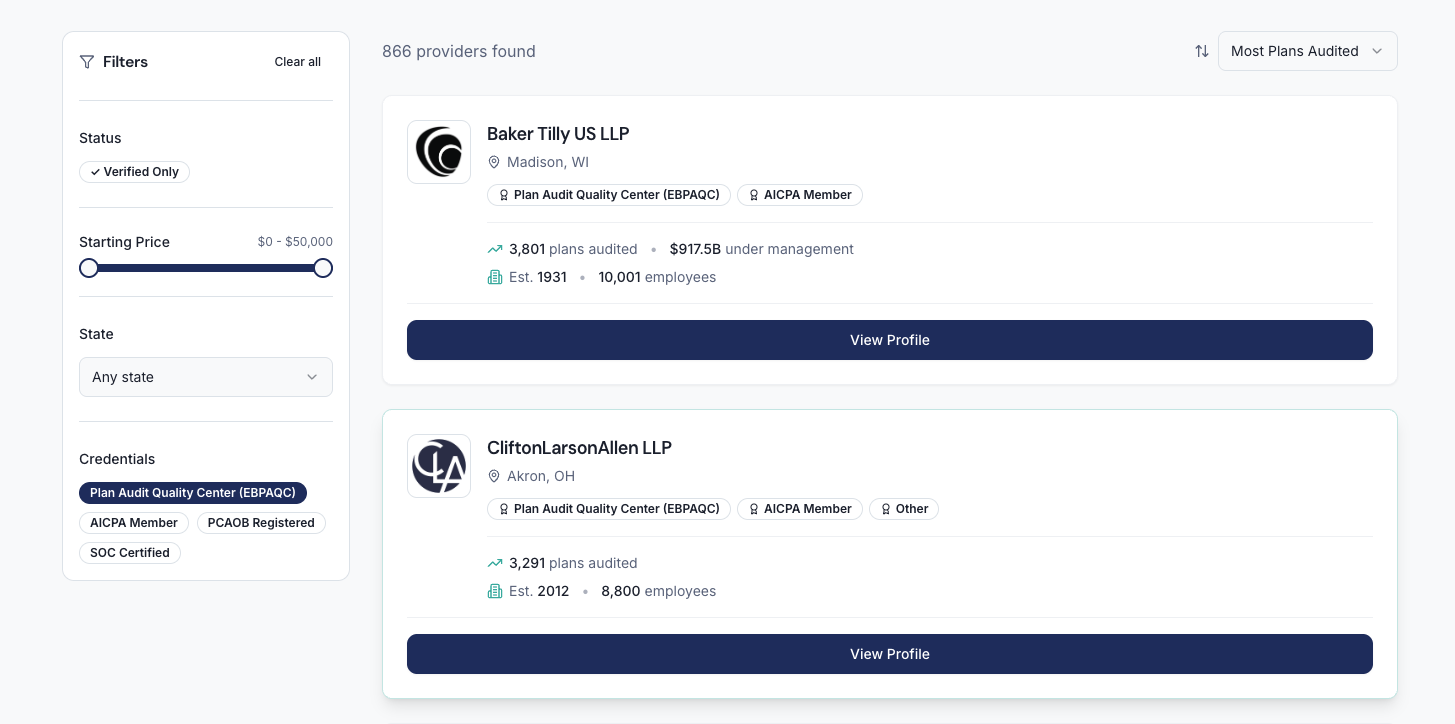
As you shortlist firms, ask directly whether they participate in the EBPAQC and what benefit plan-specific training and quality controls they maintain. EBPAQC involvement can be a strong positive signal—especially if your plan has complexity, rapid growth, multiple payrolls, or prior operational issues.
Conclusion: EBPAQC is a helpful signal—use it wisely
The Employee Benefit Plan Audit Quality Center (EBPAQC) exists to strengthen the quality of employee benefit plan audits through education, resources, and member expectations. For plan sponsors, it matters because audit quality directly affects your annual reporting, your internal workload, and your overall compliance risk.
If you’re selecting a new audit firm (or reevaluating your current one), use EBPAQC membership as one practical indicator of specialization—then confirm experience, process, and responsiveness. To start comparing firms, visit our directory of 401(k) auditors (or browse all auditors) and build a shortlist that fits your plan’s needs.