The High Cost of Non-Compliance: Penalties for Late or Rejected Form 5500 Audits
The Department of Labor (DOL) and the Internal Revenue Service (IRS) have strict protocols for these filings. Understanding the financial risks involved—ranging from daily fines to potential plan disqualification—is essential for every plan administrator.
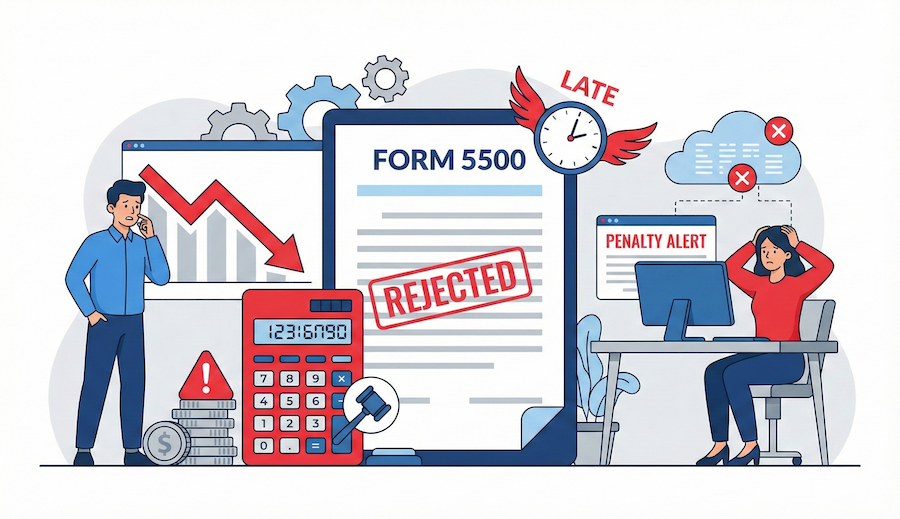
For plan sponsors, the annual Form 5500 filing is more than a routine administrative task; it is a critical compliance requirement that signals the health and legitimacy of your retirement plan to the federal government. While missing a deadline is stressful, submitting a filing that is rejected due to a missing or deficient audit report can be just as costly.
The Department of Labor (DOL) and the Internal Revenue Service (IRS) have strict protocols for these filings. Understanding the financial risks involved—ranging from daily fines to potential plan disqualification—is essential for every plan administrator.
The Rising Cost of Late Plan Filings
The fines for failing to file a Form 5500 on time are significant and have recently increased to account for inflation. If a plan administrator fails to file a complete return, the penalties can accumulate quickly, potentially threatening the financial stability of smaller plans.
As of 2025, the penalties for non-compliance are:
DOL Penalties: The DOL can assess a civil penalty of up to $2,739 per day for a late or incomplete Form 5500. There is no maximum cap on this penalty, meaning a filing that is ignored for several months could result in fines reaching hundreds of thousands of dollars.
IRS Penalties: Separately, the IRS can impose a penalty of $250 per day, up to a maximum of $150,000 per plan year.
It is important to note that these agencies often collaborate. A "red flag" triggered in the DOL’s EFAST2 system can easily lead to scrutiny from the IRS.
When an Audit Is "Missing in Action"
For "large" plans—generally those with 100 or more eligible participants—an independent audit report must accompany the Form 5500. A common misconception among plan sponsors is that filing the Form 5500 on time without the audit report will "stop the clock" on penalties. This is not the case.
If you submit a Form 5500 without the required 401(k) auditor report, the DOL considers the filing "incomplete." An incomplete filing is treated effectively the same as a non-filing. The DOL will likely reject the submission entirely, leaving the plan sponsor exposed to the daily penalties calculated from the original due date, not the rejection date.
Common Plan Audit Deficiencies That Trigger Rejection
It is not enough to simply attach any audit report; the audit must meet strict quality standards. The DOL’s Employee Benefits Security Administration (EBSA) routinely reviews filings for compliance with Generally Accepted Auditing Standards (GAAS) and ERISA requirements.
According to a sweeping study by the DOL, approximately 39% of employee benefit plan audits contained major deficiencies. These deficiencies were significant enough that the filings could have been rejected. Common reasons for rejection include:
Failure to include a signed opinion from the auditor.
Missing notes to the financial statements.
Inadequate testing of plan investments or contributions.
Using an auditor who lacks the requisite independence or specific experience.
This high error rate underscores the importance of hiring specialized employee benefit plan auditors rather than a generalist CPA who may only perform one or two plan audits a year.
The "Notice of Rejection" Timeline
If the DOL identifies a deficiency in your filing—such as a missing or substandard audit report—they will issue a "Notice of Rejection."
Once this notice is received, the plan administrator generally has a 45-day window to correct the error. This correction process is known as "perfecting" the filing.
If corrected within 45 days: The DOL will typically treat the filing as timely (assuming the original was filed on time), and penalties may be avoided.
If NOT corrected: The DOL can reject the filing entirely. At this point, the agency may assess penalties retroactively to the date the filing was originally due.
Because this 45-day window is strict, it is vital to have a responsive 403(b) auditor or health and welfare auditor who can quickly address any technical issues cited by the DOL.
Avoiding Penalties With the DFVCP
If you discover that your plan has missed a deadline or that a previous filing was never submitted, it is critical to act before the DOL contacts you. The Department of Labor offers the Delinquent Filer Voluntary Compliance Program (DFVCP).
The DFVCP incentivizes voluntary compliance by capping penalties at significantly lower rates:
Small Plans: Maximum penalty is generally capped at $750 per filing.
Large Plans: Maximum penalty is generally capped at $2,000 per filing.
Per Plan Cap: There is a $4,000 cap per plan if multiple years of delinquent filings are submitted at once.
However, eligibility for this program terminates the moment the DOL sends you a notice regarding the late filing. This makes proactive internal reviews and valid audits essential.
Finding the Right Partner
The penalties for a rejected Form 5500 highlight the necessity of quality control. Whether you manage a standard defined contribution plan, a complex defined benefit plan, or an ESOP, the auditor you choose acts as your safeguard against federal fines.
By selecting an experienced provider, you ensure that your Form 5500 is not just a submitted form, but a compliant, "perfect" filing that protects the plan sponsor and participants alike.
Additional Resources: